
market risk · wealth preservation · retirement income
How to Protect Your Retirement Savings from a Market Crash
Protecting your retirement savings isn't just about avoiding losses — it's about avoiding losses at the wrong time. Here's how to think about market risk, sequence of returns, and the tools available to protect what you've built.
The short answer
If you're approaching or in retirement, protecting your savings from a market crash isn't about predicting when the next downturn will happen. It's about making sure that when it happens — and historically, it always eventually does — you don't have to sell investments at a loss to fund your living expenses.
The danger isn't the crash itself. It's the sequence of when losses occur. A 30% drop in your portfolio at age 40 is recoverable. The same 30% drop at age 65, while you're drawing income from those same investments, can permanently damage your retirement plan.
This post explains what sequence-of-returns risk is, why it matters most for retirees, and the tools available to protect your savings.
A note on timing: where we are right now
As of mid-2026, U.S. markets are at or near all-time highs. That's good news for anyone whose retirement plan has benefited from years of growth — but it also means the downside risk is real. Markets at all-time highs aren't more likely to crash than markets at any other time, but they have more room to fall when corrections come. And historically, the periods of greatest investor complacency have often preceded the most painful corrections.
This isn't a market prediction. Nobody knows when the next downturn will arrive. What we know with certainty is that downturns happen, and that retirees who haven't planned for them are the ones who get hurt most. Now — while balances are strong and you have flexibility — is when protection strategies are easiest to implement.
How sequence-of-returns risk affects your retirement
Most people understand that markets go up and down. What's less understood is that the order in which those ups and downs occur dramatically affects retirement outcomes — even when the average return is exactly the same.
Consider two retirees with identical $1 million portfolios, both withdrawing $50,000 per year for income. Both experience the same average annual return over 25 years. The only difference: one retires into a strong market, and one retires into a weak one.
Retiree A: Strong early returns
- Years 1–5: Markets rise sharply
- Years 6–10: Markets correct and stay flat
- Years 11–25: Modest growth
After 25 years: Portfolio remains healthy, often growing despite withdrawals.
Retiree B: Weak early returns
- Years 1–5: Markets drop 30%, partially recover, then drop again
- Years 6–10: Markets recover modestly
- Years 11–25: Strong growth
After 25 years: Portfolio is severely depleted or exhausted — potentially running out of money in their early 80s, despite having the same average return as Retiree A.
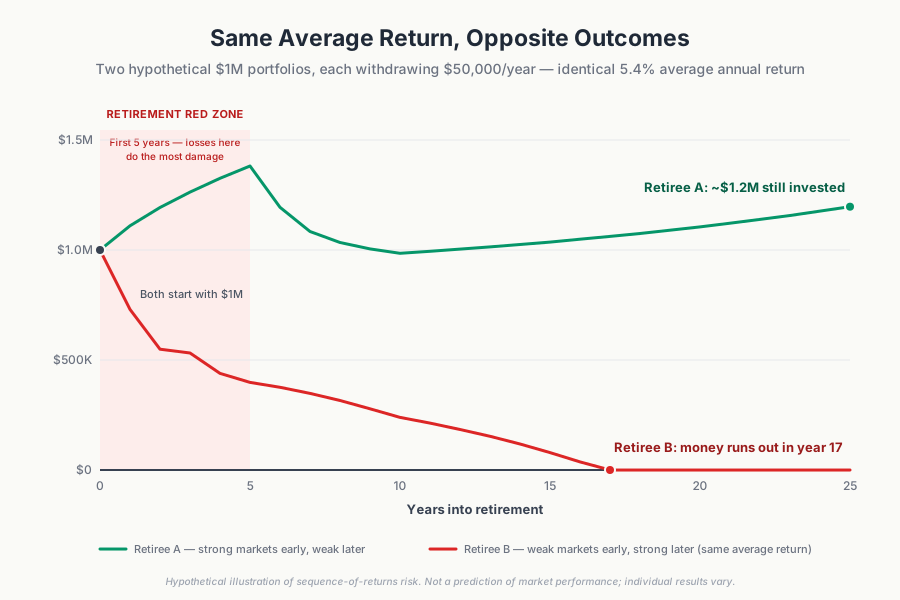
The difference is sequence-of-returns risk. Losses early in retirement are exponentially more damaging than losses later, because you're selling investments to fund living expenses while their value is down. Every dollar you sell at a loss is a dollar that can't participate in the recovery.
This is why "I'll just wait for the market to come back" doesn't work the same way in retirement as it does during your working years. When you're working, you have time to wait. When you're retired and drawing income, you don't.
An example: Robert and Sarah, age 64
Let me walk through a scenario I often use in Retirement Wealth Academy classes. (Names changed, situation simplified for illustration.)
Robert and Sarah's situation:
- Both 64, planning to retire next year
- Combined retirement savings: $1.5 million
- Expected combined Social Security: $55,000/year starting at full retirement age
- Spending need in retirement: $90,000/year (after Social Security: need ~$35,000/year from portfolio)
- Investment philosophy: Comfortable with markets, want to "stay invested"
- Portfolio: 70% stocks, 30% bonds, diversified index funds
They've done well. Their portfolio is at an all-time high. They're feeling confident about retirement.
Then, six months into retirement, the market drops 35% over the next 14 months.
Scenario A: Without a protection strategy
Robert and Sarah are forced to sell investments at a loss to fund their $35,000/year withdrawals. Even though markets eventually recover, they've now sold a meaningful portion of their portfolio at depressed prices. Their portfolio recovers — but it never fully catches up to where it would have been if they hadn't had to sell during the downturn.
Stress-testing shows their plan may run out of money in their mid-80s, instead of comfortably lasting into their 90s. Their retirement isn't ruined, but it's permanently constrained — they'll likely need to reduce spending, change plans, or worry about money for the rest of their lives.
Scenario B: With a protection strategy
A coordinated protection strategy can include several elements:
- A cash and short-term reserve of $70,000–$100,000 (2–3 years of portfolio withdrawals), so they're never forced to sell investments during a downturn. When markets drop, they spend down the cash bucket; when markets recover, they refill it.
- A defined-outcome portfolio sleeve using strategies that participate in market gains while providing built-in downside protection — limiting how much of any single year's loss actually shows up in their account.
- Bond ladders providing predictable income from high-quality bonds maturing in sequence over the next several years.
- Optionally, a guaranteed income sleeve if they're comfortable with annuities — providing a portion of their lifetime income that doesn't depend on market performance at all.
The result: When the 35% drop happens, they don't panic-sell, they don't change their lifestyle, and their long-term plan stays intact. The downturn becomes an event to weather, not a crisis to survive.
The toolkit: protection strategies for every type of investor
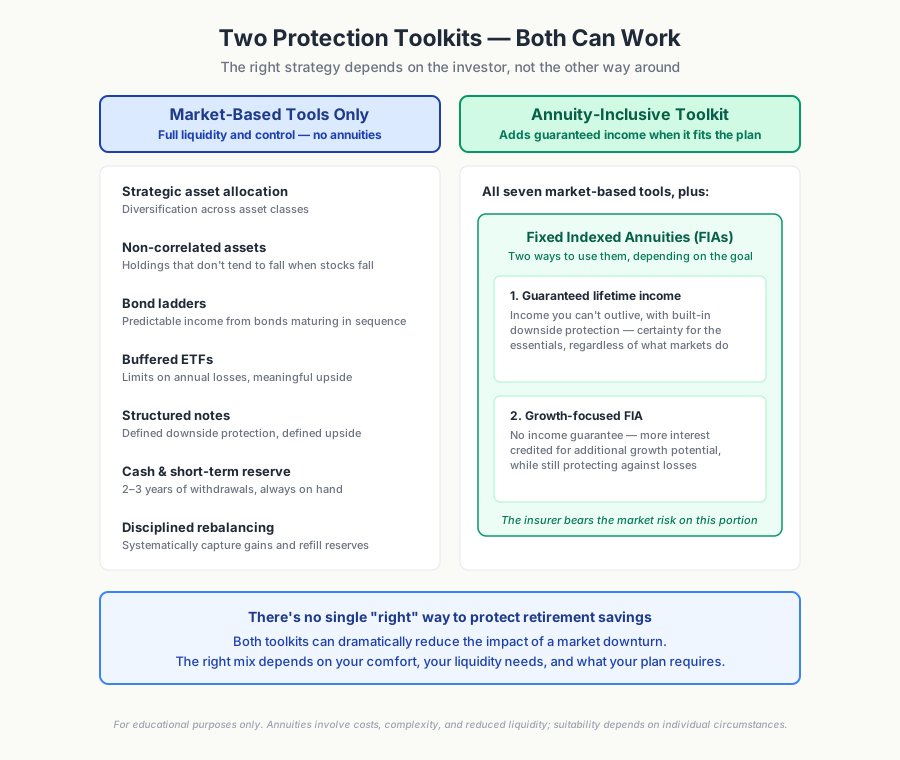
Here's something many retirees don't realize: there's no single "right" way to protect retirement savings. The right strategy depends on your situation, your comfort with different financial tools, and your specific goals.
We work with two kinds of investors, and both deserve good protection strategies.
For investors who prefer market-based solutions only
Some investors don't want to use annuities. Maybe they don't like the complexity or want full liquidity and control. Their concerns are valid — and there are excellent protection strategies that don't use annuities at all.
For these investors, we typically focus on:
- Strategic asset allocation with diversification across asset classes that historically move differently from each other
- Non-correlated assets added to a portfolio of stock and bond funds — investments that don't tend to fall when stocks fall
- Bond ladders providing predictable income from high-quality bonds maturing in sequence
- Buffered ETFs that limit downside losses in any given year while still capturing meaningful upside
- Structured notes providing defined outcomes — specific protection against losses up to a certain point, with defined upside participation
- Cash and short-term reserves sized to cover 2–3 years of expenses, so portfolio downturns don't force selling
- Disciplined rebalancing to systematically capture market gains and refill protective reserves
These tools, used together, can dramatically reduce the impact of a market downturn without requiring any guaranteed income or other similar products.
For investors who are comfortable with annuities
Other investors do want guaranteed income they can't outlive. They've seen what happens to people who run out of money in their 80s, and they want certainty for the essentials.
For these investors, the toolkit expands. In addition to the market-based tools above, we may also use some bond alternatives or Fixed Indexed Annuities (FIAs) that provide either:
- Guaranteed lifetime income with downside protection, or
- Growth annuities that don't offer guaranteed income, but have more interest credited for additional growth potential — while still offering downside protection.
In both cases, the insurance company bears the market risk on a portion of your retirement strategy.
How we decide what's right for each client
We start with two questions:
- What kind of investor are you? Some people genuinely prefer the control and liquidity of market-only strategies. Others sleep better without any losses and/or with guaranteed income from insurance products. Both are valid — and both can be done well.
- What does your plan actually need? If your essential expenses are already covered by Social Security and a pension, your portfolio can take more risk. If your portfolio has to generate most of your income, protection becomes more important.
There's no universally right answer. There's the right answer for you.
What this means for your retirement plan
A few principles I share when I teach Retirement Wealth Academy classes:
1. Protection isn't about predicting market crashes. It's about preparing for them.
Nobody knows when the next downturn will happen. The strategies that work aren't market-timing strategies — they're structural protections that work regardless of when corrections come.
2. The five years before and after retirement are the most vulnerable.
This is the "retirement red zone" — the window when sequence-of-returns risk is most acute. Protection strategies are most valuable during this period, even if they cost a small amount of upside potential during good markets.
3. Being too conservative carries its own risk.
Keeping everything in cash and CDs feels safe, but inflation slowly erodes purchasing power over a 25–30 year retirement. The goal isn't to avoid the market — it's to participate in growth while limiting catastrophic losses.
4. The best time to set up protection is when you don't need it.
Markets at all-time highs are the easiest time to implement protection strategies, because you're starting from a position of strength. After a crash, protection is much harder to put in place — and much more expensive.
5. The right toolkit matches you, not the other way around.
A protection strategy should reflect your comfort with different financial tools, not push you into products you're not comfortable with. There are excellent strategies for every type of investor.
6. Your advisor's role during a crash matters as much as your portfolio's design.
The biggest cause of permanent investment damage isn't markets — it's behavior. Studies consistently show that investors earn meaningfully less than the funds they own, because they buy near peaks and sell near bottoms. The largest gap between fund returns and investor returns shows up during the worst market periods, when emotion overrides discipline.
This is why an advisor's role during a crash is often more valuable than during good markets. When the headlines are scary, when account statements show losses you've never seen before, when friends and family are convinced this time is different — that's when having a written plan, a pre-committed strategy, and someone to talk it through with becomes most valuable.
We've watched clients ride through 2020, 2022, and every other recent disruption without panic-selling — not because they were unaffected emotionally, but because the plan was already in place and we were there to talk through it. That structure isn't glamorous, but it's one of the most important forms of protection a retiree can have.
The bottom line
Protecting your retirement from a market crash isn't about predicting when the next downturn will happen. It's about making sure that when it happens, you've already built the structure to weather it.
Sequence-of-returns risk is the biggest threat retirees face — and it's also one of the most preventable. The tools to address it exist for every type of investor, whether you prefer market-based strategies, are comfortable with annuities, or want a combination of both.
The current moment — with markets at all-time highs — is one of the best windows to think through these protections. Not because a crash is imminent, but because protection is easiest to implement from a position of strength.
If you'd like to think through how a coordinated protection strategy might fit your retirement plan — including which tools match your investment preferences and your specific situation — that's the kind of analysis we do at Hartman Retirement Partners.
Learn more about our wealth preservation services →
Hartman Andersen is an Investment Adviser Representative (CRD #7001766) affiliated with Brookstone Capital Management, LLC, an SEC-Registered Investment Adviser. He helps pre-retirees and retirees in St. George, Utah and nationwide build retirement plans focused on protection, sustainable income, and coordinated tax planning. He teaches Retirement Wealth Academy courses at local colleges, universities, and libraries throughout the region.
How much can the market actually drop?
History gives us reference points. The S&P 500 has experienced multiple drops of 30% or more over the past century, including 1929–1932 (-86%), 1973–1974 (-48%), 2000–2002 (-49%), 2007–2009 (-57%), and 2020 (-34% in five weeks). The historical pattern is clear: significant drops happen periodically. The question isn't whether they will happen again — it's whether you're prepared when they do.
Should I just go to cash before a crash?
Almost never. Predicting market crashes is notoriously difficult, even for professionals — and being out of the market for even a few of the best days can dramatically hurt long-term returns. Effective protection strategies work without requiring you to predict timing.
Are annuities a good way to protect my retirement?
For some investors, yes. For others, no. Annuities can provide guaranteed lifetime income and downside protection, but they come with costs, complexity, and reduced liquidity. Whether they fit your plan depends on your overall situation, your other income sources, and your comfort with insurance products. We use them when they solve a specific problem in a plan, and we don't use them when they don't.
What's the difference between buffered ETFs, structured notes, and fixed indexed annuities?
All three provide some form of downside protection in exchange for some limit on upside, but the mechanics, costs, and tax treatment differ significantly. Buffered ETFs trade on exchanges with daily liquidity. Structured notes are typically held to maturity and issued by banks. Fixed indexed annuities are insurance products with the strongest protection but reduced liquidity. The right tool — or combination of tools — depends on your situation.
How much of my portfolio should be in protection strategies?
It varies dramatically based on your situation. Someone with substantial Social Security and a pension covering their essential expenses can take more risk with their portfolio. Someone whose portfolio has to generate most of their retirement income needs more protection. We typically work backward from your income needs and time horizon to determine the right mix.
When should I start thinking about this?
Five to ten years before retirement is the ideal window — early enough to position your portfolio before the most vulnerable period (the "retirement red zone"), and while markets are favorable. After retirement, protection strategies are still important, but the implementation is harder if markets have already corrected.