
social security · tax planning · retirement income
When Should You Claim Social Security?
Choosing when to claim Social Security is one of the highest-impact retirement decisions you'll make — and it shapes your taxes, your survivor benefit, and your whole plan.
The short answer
There is no single right age to claim Social Security. For most people, "as soon as I'm eligible at 62" is the most expensive answer — but the right age depends on your health, your spouse, your other income sources, your tax situation, and your overall retirement plan.
What most retirees don't realize is that when you claim Social Security affects how much of your benefit gets taxed. That's because Social Security can be taxable depending on your "provisional income" — and the timing of your claim, combined with your other withdrawals, directly shapes that number.
This post walks through the basic claiming decision, explains provisional income in plain language, and shows a real-world example of how the right timing can save tens of thousands of dollars over a retirement.
How the Social Security claiming decision works
You can start claiming Social Security as early as age 62. You can also delay it as late as age 70. In between is your "full retirement age" — 66 to 67 for most people approaching retirement now.
The math is roughly this:
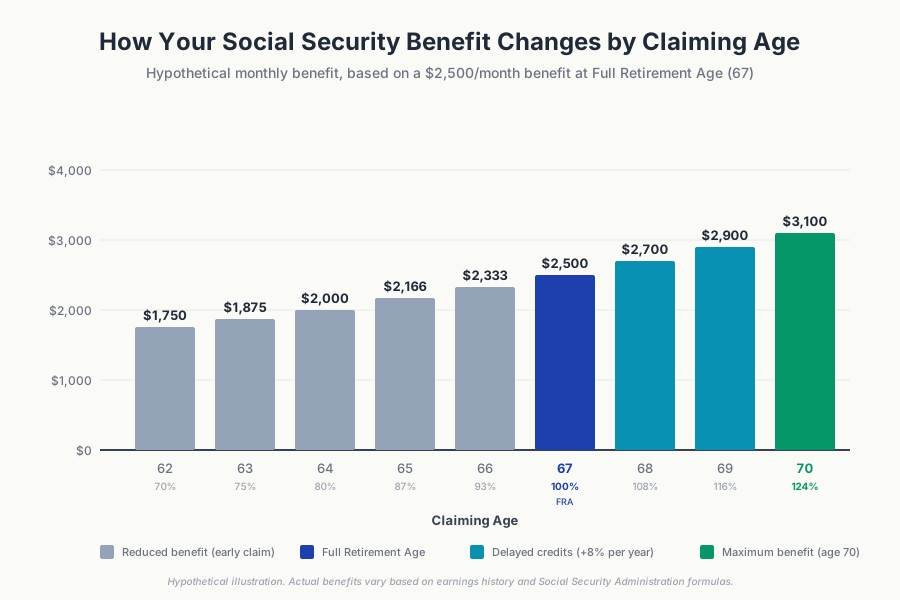
Delaying past full retirement age increases your benefit by about 8% per year, up to age 70. After 70, there's no further benefit to delaying.
So why don't more people delay? Three reasons:
- Cash flow. Some people genuinely need the income at 62 because they're retired and don't have other sources.
- Health concerns. If you don't expect to live long, claiming earlier captures more total benefits.
- Misunderstanding the math. Most people don't realize how much their lifetime benefit changes based on when they claim — especially for the surviving spouse.
But there's a fourth factor that almost nobody discusses, and it's often the most important one for retirees with savings: taxes.
What provisional income is, and why it matters
Most people assume Social Security is tax-free. It's not — at least, not always.
Whether your Social Security benefits get taxed depends on something called your provisional income (sometimes called "combined income"). The formula:
Provisional income = your adjusted gross income + tax-exempt interest + 50% of your Social Security benefits
The IRS then uses your provisional income to determine how much of your Social Security gets taxed:
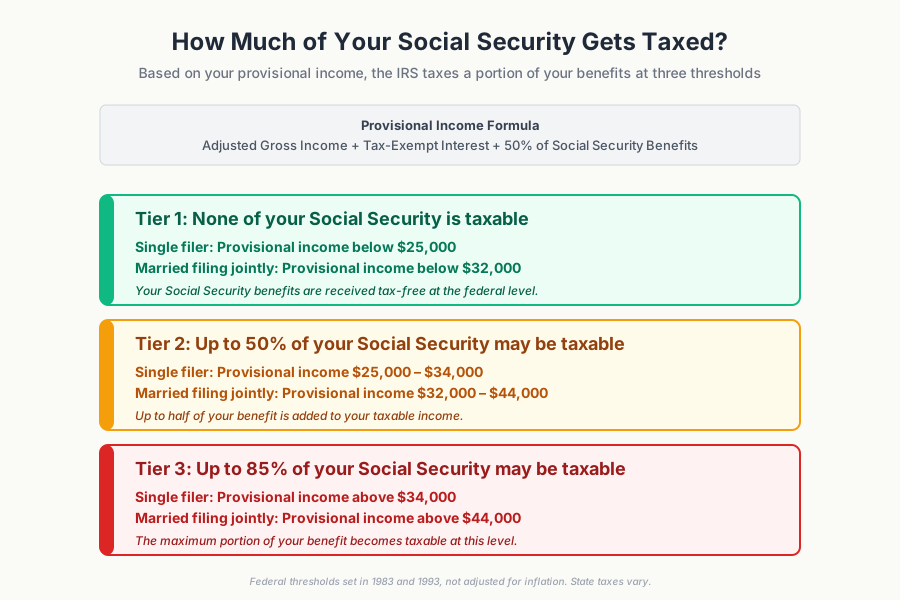
Those thresholds, by the way, were set in 1983 and 1993 and haven't been adjusted for inflation since. That means more retirees cross them every year, even at modest income levels.
Here's another reason timing matters: many financial planners and economists argue that future federal tax rates are likely to rise. The reasoning is straightforward — the U.S. national debt has grown substantially, Social Security and Medicare face long-term funding pressures, and current tax rates are historically low compared to much of the 20th century. If you believe tax rates may be higher in the future than they are today, paying taxes now through Roth conversions — at known rates, in a controlled way — becomes a more compelling strategy. The window between retirement and age 73 is often when you have the most control over your tax rate, which is why we focus heavily on coordinated tax planning during those years.
Here's why this matters for claiming decisions: the timing of when you claim Social Security, combined with when and how you draw from your retirement accounts, directly determines your provisional income — and therefore how much tax you pay on your benefits.
An example: Tom and Linda, age 65
Let me walk through a scenario I often use in Retirement Wealth Academy classes. (Names changed, situation simplified for illustration.)
Tom and Linda's situation:
- Both 65, both recently retired
- Expected Social Security: $50,000 per year combined ($25,000 each)
- Pension income: $40,000 per year (Tom's former employer)
- Retirement accounts: $1.2 million in traditional IRAs
- They need about $90,000 per year to live on
- They assumed Social Security was tax-free
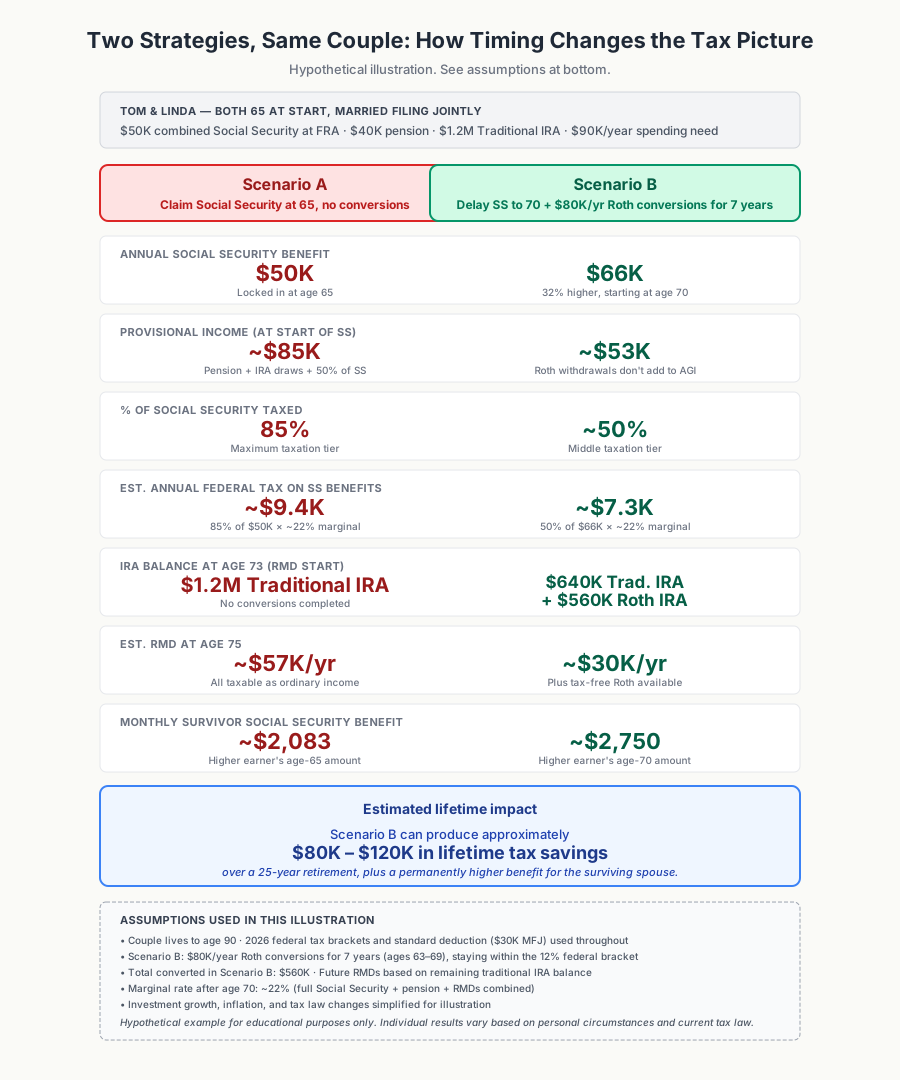
Scenario A: Claim Social Security immediately at 65, draw from the IRA for the rest
Tom and Linda claim Social Security right away. With $50,000 from Social Security plus $40,000 from the pension, they're at $90,000 — but they still need more after taxes. So they pull another $20,000 from the IRA.
Their tax picture:
- Pension income: $40,000 (fully taxable)
- IRA withdrawal: $20,000 (fully taxable)
- Provisional income: $40,000 + $20,000 + $25,000 (half of Social Security) = $85,000
- 85% of their Social Security ($42,500) gets taxed
Lifetime tax impact: significant. And because they're claiming early, their benefit is locked in at the lower amount for life — including for the surviving spouse.
Scenario B: Delay Social Security to age 70, do Roth conversions in the gap years
Tom and Linda delay Social Security to 70 and use IRA withdrawals to bridge the gap. They also do strategic Roth conversions during the years before claiming — moving money from the traditional IRA to a Roth IRA while their tax bracket is lower (because Social Security isn't yet in the picture).
By converting $80,000 per year for seven years (a total of $560,000), they stay within the 12% federal tax bracket the entire time — taking advantage of one of the lowest tax-rate windows of their lives.
By the time they turn 70:
- Their Social Security benefits are roughly 32% higher (due to delayed retirement credits)
- A meaningful portion of their IRA has been converted to Roth
- Roth withdrawals don't count as taxable income — and don't count toward provisional income
- When Social Security starts at 70, less of it gets taxed because their AGI is lower
- Future required minimum distributions (RMDs) are smaller because the traditional IRA is smaller
- They now have a tax-free Roth bucket to draw from for flexibility
The combined effect over a 25–30 year retirement: potentially tens of thousands of dollars in lifetime tax savings, plus a permanently higher Social Security benefit — including for the surviving spouse.
Here's how the two strategies compare, side by side:
What this shows
Scenario A isn't "wrong." For some retirees — those with health concerns, limited savings, or specific income needs — claiming early is the right move.
But Scenario B illustrates the broader point: your claiming decision isn't just about Social Security. It's a tax decision, an estate decision, and a portfolio longevity decision all at once. The right answer requires looking at your whole financial picture, not just the Social Security claiming chart.
What this means for your claiming decision
A few principles I share when I teach Retirement Wealth Academy classes:
1. The default answer ("claim as soon as I'm eligible") is rarely the best answer.
For most retirees with savings, delaying makes sense — especially in years where you can use the gap to do Roth conversions or reduce future RMDs.
2. Your claiming decision affects your spouse, not just you.
For married couples, the higher-earning spouse's claiming age determines the survivor benefit. Delaying for the higher earner often makes the most lifetime difference for the survivor.
3. The "break-even" calculation is incomplete.
The classic break-even framework — "claim early and bank the money vs. claim late and get a bigger check" — ignores taxes, market returns, longevity risk, and spousal coordination. It's not wrong, just incomplete.
4. Look at it inside a financial plan, not in isolation.
The same person can have different "right answers" depending on their broader plan. Your tax bracket, your other income, your portfolio structure, and your spouse's situation all matter.
The bottom line
The "when to claim Social Security" question is one of the highest-impact financial decisions you'll make in retirement — and it's almost never just about Social Security. It's tangled up with your taxes, your portfolio, your spouse's situation, and your long-term plan.
For most retirees with savings, the conventional wisdom of "claim at 62" leaves real money on the table. But "always delay until 70" isn't universally right either. The answer comes from looking at your full picture.
If you want to think through this inside the context of your overall retirement plan — including taxes, Roth conversion opportunities, and survivor planning — that's the kind of analysis we do at Hartman Retirement Partners.
Learn more about our retirement planning services →
Hartman Andersen is an Investment Adviser Representative (CRD #7001766) affiliated with Brookstone Capital Management, LLC, an SEC-Registered Investment Adviser. He helps pre-retirees and retirees in St. George, Utah and nationwide build retirement plans focused on protection, sustainable income, and coordinated tax planning. He teaches Retirement Wealth Academy courses at local colleges, universities, and libraries throughout the region.
Is it better to claim Social Security at 62 or 67?
For most people with savings, 67 (or later) produces a higher lifetime benefit. Claiming at 62 permanently reduces your benefit by 25–30%. But the right answer depends on your health, marital status, other income sources, and tax picture. Looking at the decision inside a financial plan is the only way to answer it accurately.
Will my Social Security be taxed?
Probably yes, at least partially. Most retirees with pensions, IRA withdrawals, or other taxable income end up with 50–85% of their Social Security being taxable at the federal level. Whether your state taxes Social Security depends on where you live — Utah, for example, partially taxes Social Security.
Can I reduce the taxes on my Social Security?
Yes, often significantly. Strategies include delaying your claim to reduce provisional income during gap years, doing Roth conversions before claiming, choosing tax-efficient investment locations, and timing withdrawals from different accounts strategically.
What happens to Social Security if my spouse dies?
The surviving spouse keeps the higher of the two benefits. This is why the claiming decision for the higher-earning spouse matters so much — it determines what the surviving spouse will receive, potentially for many years.
Should I delay claiming if I expect to live a long time?
Generally yes. Longevity is one of the strongest arguments for delaying. If you live into your late 80s or beyond — which a 65-year-old today has a meaningful chance of doing — delaying to age 70 typically produces more total lifetime benefit.
How do I know what's right for me?
By running the numbers inside a comprehensive plan that considers your tax situation, your spouse's situation, your other income, and your specific goals. The general rules above help you understand the framework, but the right answer for you is specific to your situation.